


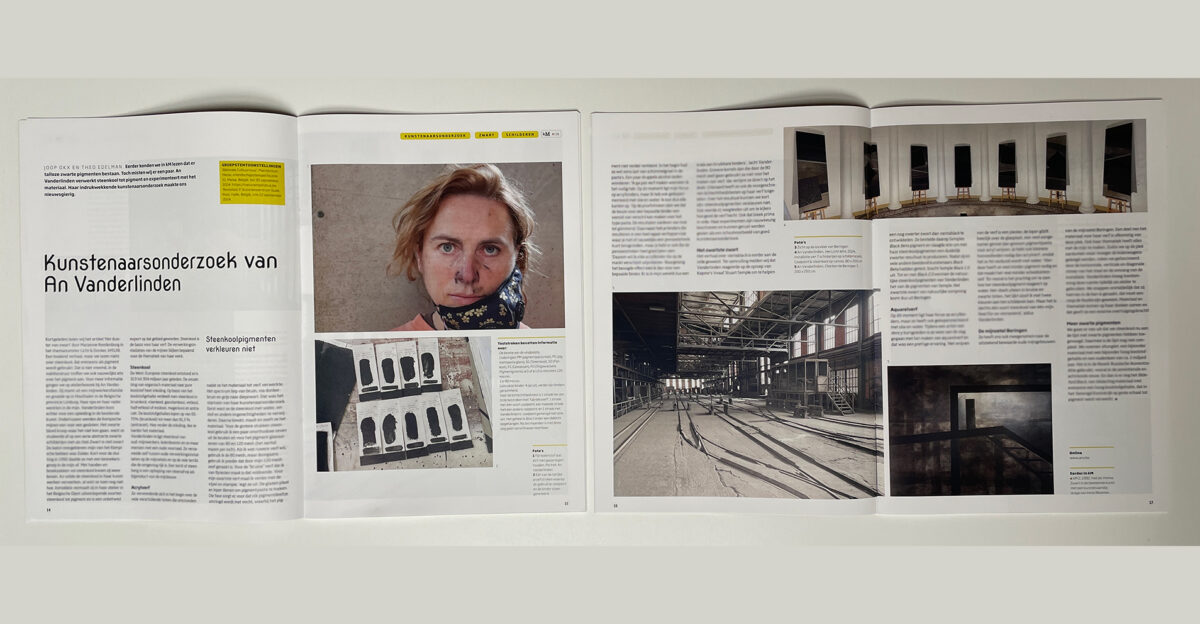
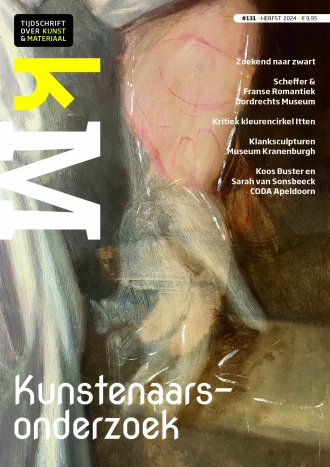
 In preparation for the article ‘ Artist’s research by An Vanderlinden ’, published in the autumn issue of kM (still on sale, see link below), Joop Okx did in-depth research into coal as a pigment. His surprise that almost nothing can be found about it in the literature was as great as my own seven years ago. It seems so obvious, but it is not.
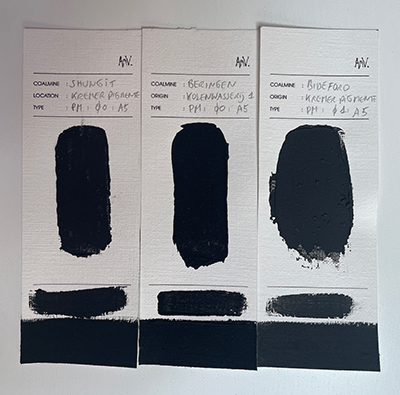
The only 2 traces of the use of coal as pigment that he could find were 1) the use of Shungite, a ca. 2-billion-year-old material with a particularly high carbon content in northern Russian icon painting, especially in the 17th and 18th centuries, and 2) Bideford Black from the UK. This was widely processed into pigment there, from the 13th century until 1969.
Now I suspect that by my question 7 years ago to Kremer Pigmente, I woke someone up there. Back then there was no coal for sale as a pigment, and now…. indeed, both regular coal, i.e. Anthracite, as well as Shungite, and Bideford Black. The latter they have started mining back themselves, by the way. So I had to test that!
I ground up a piece of the Shungite that Joop Okx donated to me during the interview (for which thanks again!), and ordered the Shungite and Bideford Black pigments from Kremer. I then made pigment pastes from all of the above, and from my own Charbon de Beringen. I also made the paint tests of all of them in identically the same way. I was very curious to see if Shungite would be blacker. Or Bideford Black?
The result: they are all very, very black. But now guess which coal is blackest?
Indeed : Charbon de Beringen.
Limburg above! :-D
Article ‘Artist research by An Vanderlinden’ in the magazine “artistMaterial” by Joop Okx and Theo Edelman
4 pages, kM Magazine #131
This magazine (in NL) can be bought separately at : https://tijdvoortijdschriften.nl/losse-nummers/km-magazine-nr-131-van-2024
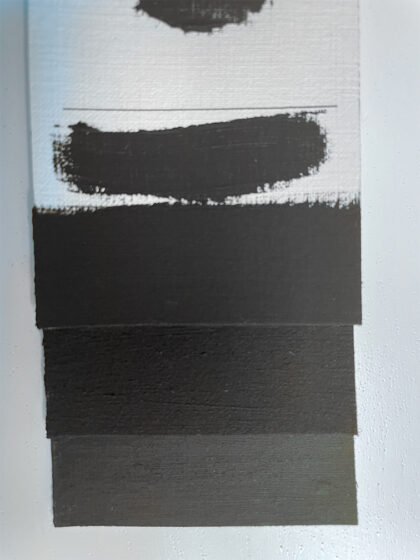
NB: 7 years ago, I made the blackest black paint. That is not the same as the blackest black, as I also wrote then. Since then, a lot has happened in terms of paint development: several manufacturers released black paint’ based on nanotechnology in a race against each other. Black 4.0, Muso Black, … are blacker than mine. But of all the paints made with MINERAL pigments, mine is the blackest…. as far as I know now ;-). In science, one should always speak with 2 words, which is often forgotten these days ;-).
PS: I also like to remind people of the fact that the person who started the blackest black hype by inventing carbon nanotubes, is the belgian artist Frederik De Wilde. Today is a perfect day to re-read this 2013 article about him: https://www.vice.com/en/article/meet-the-artist-behind-blacker-than-black-the-darkest-color-ever/ or better, read about his project on his website: https://frederik-de-wilde.com/project/nasablck-crcl1/